How we work
What an engagement looks like from your side
Most security proposals describe what a vendor will do. This page describes what you will see while they do it: when findings reach you, what arrives with them, who you talk to, and what you are holding at the end.
Seven phases, and what each one puts in your hands
These are the phases published on our methodology page. The difference here is the second column: what the engagement looks like from where you are sitting.
Discover
Before anything is quotedUnderstand the product, the release, and where failure hurts most.
- What you see
- A first conversation with the engineers who would deliver the work, not a sales team. You leave with a shared view of the risk in play and of which artifact will settle it.
- What you do
- Bring the audit date, the security questionnaire, or the release plan. We work backwards from what you need to prove.
Scope
Before the first test runsTargets, rules of engagement, and evidence out, agreed in writing.
- What you see
- Written scope, signed rules of engagement, agreed communication channels, and a mutual non-disclosure agreement. The people on the scoping call are the people who run the work.
- What you do
- You set scope and sign the rules of engagement. Anything the engagement depends on exists on paper first.
Engineer
While testing runsSenior engineers run the work, with daily contact.
- What you see
- Daily contact and triaged findings with clear severity calls. A critical finding reaches you the day it is demonstrated. Nobody waits for the report to learn bad news.
- What you do
- Stay reachable for the calls that matter. You can start fixing the first finding while the rest of the scope is still being exercised.
Validate
As findings landFindings demonstrated, ranked, and written to be acted on.
- What you see
- Each finding demonstrated with reproduction steps and evidence of impact, ranked by exploitability rather than scanner score. An executive summary your board can read sits alongside technical detail your engineers can act on.
- What you do
- Review each demonstrated finding with its evidence. Remediation guidance arrives ordered, so your team knows what to fix first.
Retest
After your fixes landFixes verified, the report updated.
- What you see
- Each fix checked against the original reproduction steps, and the report updated to say remediated and retested, which is the phrase auditors look for.
- What you do
- Tell us when the fixes are in. You fix on your own schedule, not ours.
Transfer knowledge
At handoverThe capability becomes your team's.
- What you see
- Handover documentation, pairing sessions, and the framework, CI integration, and maintenance playbook. You own all of it.
- What you do
- Your engineers pair with ours during handover, so the first person to maintain the work has already run it.
Support
Next cycle onwardRepeat on your cadence, co-run, or hand over.
- What you see
- Evidence that stays current: refreshed reports each cycle, regression packs that grow with every finding, and detection content built from what testing proved exploitable.
- What you do
- Choose the shape. Run by us, co-run with your team, or handed over entirely once it is self-sustaining.
The systems your engagement runs on
We build and operate the platforms our own engineers work in. That matters to you for one reason: when we describe how a finding was validated or how an alert was judged, we can show the system that did it rather than describe a process. The screens below are the operator view our team works in. You are not asked to learn a tool or maintain a login; what the platform produces reaches you through the report, the working sessions, and the retest record.
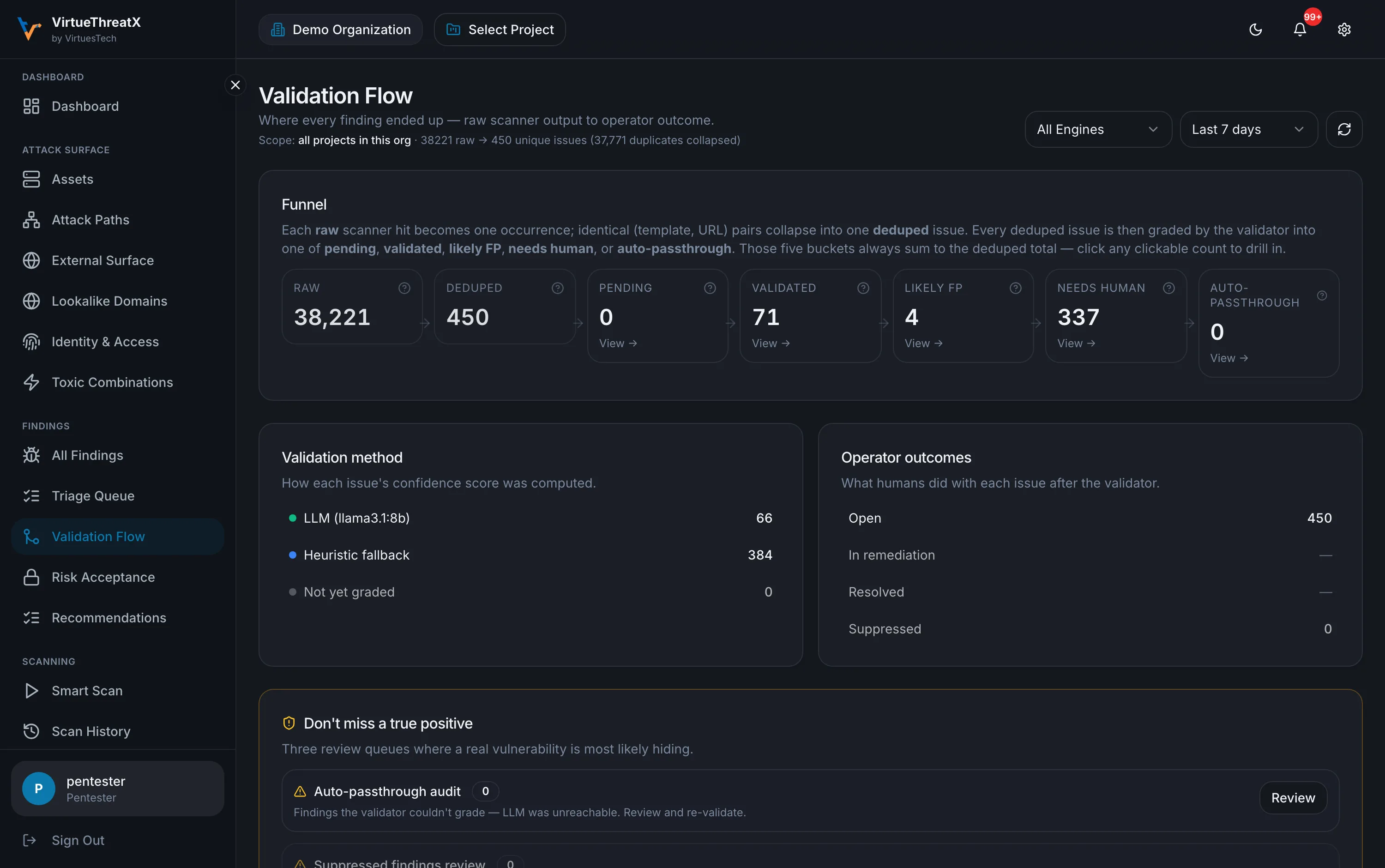
Findings are validated before they are reported, so what lands on your remediation list has evidence behind it. The four states this produces are explained on the VirtueThreatX page.
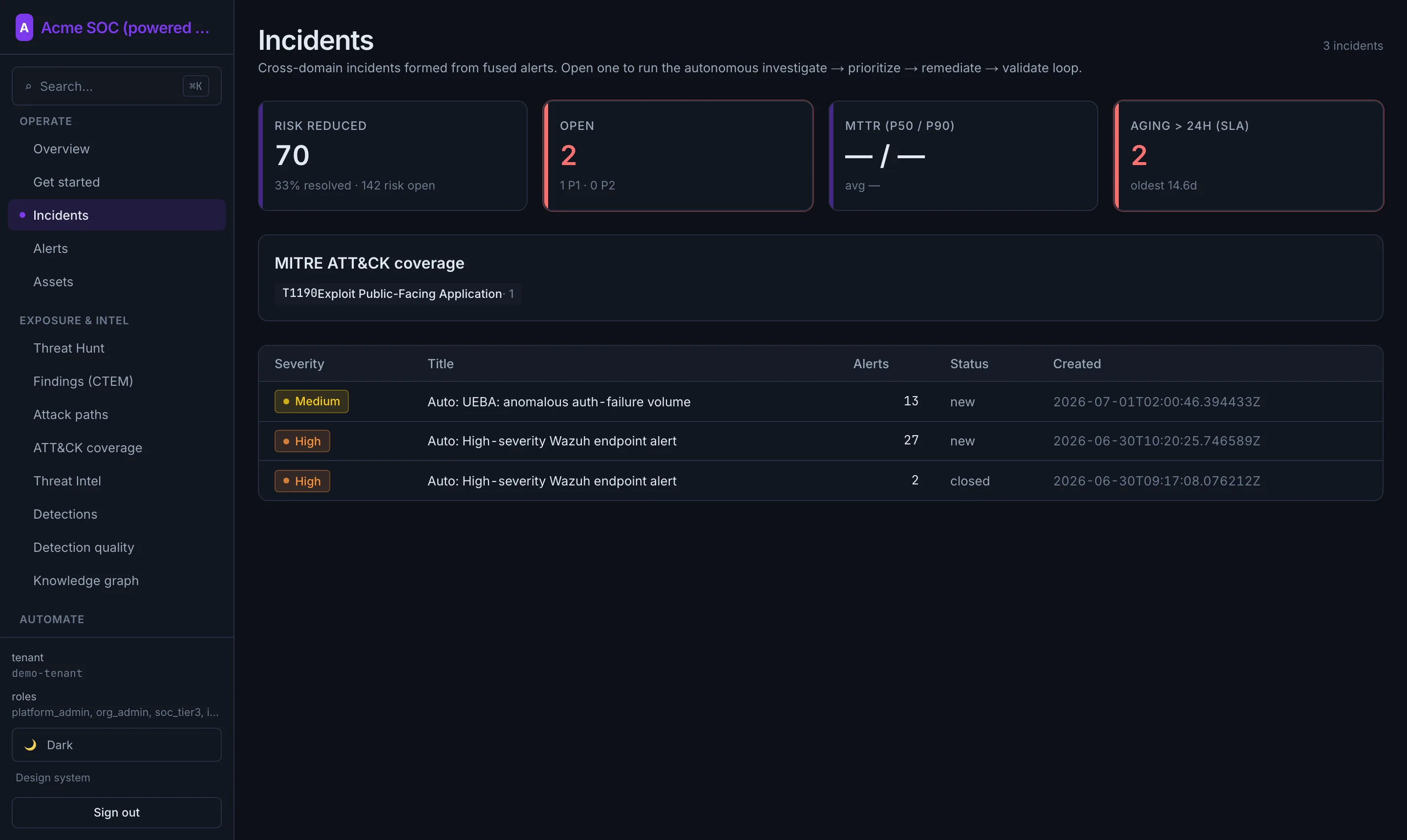
On managed security, a 30-day pilot connects your telemetry and you review what was detected and how it was triaged before committing to anything. The pilot terms are on the managed security page.
What you are holding at the end
A retest-verified report you can hand to an auditor or an enterprise customer as it stands. You can read a real finding from one, reproduced in full with no email required, in our section-by-section walkthrough of the sample report.
The engagement does not have to end there. A proven finding can become a regression test your pipeline runs on every release, and its indicators can become detection content, so the same problem cannot return quietly. That is the assurance loop, and it is what separates a report from a closed risk.
Ready to scope the work?
A 30-minute call with the engineers who will do the testing, not a sales gate.