Skip to content

Cybersecurity · Managed Defense

Audition the SOC before you buy it

Insurers and customers ask who watches your environment overnight. Our Managed SOC runs on VirtueShieldX, which we built and operate; one managed-security provider already runs its L1 and L2 coverage on it. Start with a 30-day pilot on your telemetry.

How it’s delivered
  1. 01Pilot (30 days)Agents go onto a representative slice of your estate. Every detection and report you evaluate comes from your environment.
  2. 02OnboardStructured rollout across your estate: log sources, playbooks, and escalation paths agreed, tested, and signed off.
  3. 03OperateRound-the-clock monitoring against defined response targets, with final SLAs committed in your service agreement.
  4. 04ReviewA monthly review in plain language: incidents, what detection tuning changed, and where coverage gaps remain.

Engineering-led cybersecurity and quality engineering since 2020, delivered by senior security & quality engineers on platforms we build and run ourselves.

Experienced analysts are hard to hire: in ISC2's 2025 workforce study, 59% of respondents cited critical or significant skills needs, up from 44% in 2024. Meanwhile an intrusion does its damage in the hours no one is watching.

Anatomy of an incident

One alert, traced through the loop

How one signal moves from raw telemetry to a contained, closed incident on VirtueShieldX, with a human approving every consequential step.

1

Telemetry

Wazuh · feeds · Trivy

Endpoint, network, cloud, and vulnerability signals stream in from your estate into the platform's single data model.

2

Detection

2,250+ ATT&CK-mapped rules · UEBA

Rules and behavioral analytics fire on the signal, e.g. an anomalous auth-failure volume mapped to a MITRE technique.

3

Investigation

AI triage

Related alerts are fused into one cross-domain incident and enriched with context automatically, so an analyst opens one case instead of forty alerts.

4

Prioritization

Risk scoring

The incident is ranked by risk and exploitability, so analysts know what to work now and what can wait.

5

Approval gate

Human analyst

A containment playbook is proposed. Nothing runs on your systems until a named analyst approves, and it can run in dry-run mode first.

6

Response & validate

SOAR playbook

On approval, the playbook contains the threat; the outcome is verified, the incident closed, and the result feeds detection tuning for next time.

The 30-day pilot

What you get before you commit

  • Your telemetry, not a demo dataset. Agents go onto a representative slice of your estate, and every detection, triage decision, and report you judge was generated by your own environment. A demo dataset can only prove we're good at demos.
  • The same screens our analysts use. Risk posture, fused incidents, MITRE ATT&CK coverage, and remediation playbooks, evaluated inside the working platform.
  • Response playbooks in dry-run first. Containment playbooks execute in simulated mode under the human approval gate, so you watch exactly what automated response would have done before anything can touch your systems.
  • Reporting you can hand upward. Evidence aligned to NIST, ISO 27001, and SOC 2 expectations, in the same format your leadership, auditor, or insurer will see in service.
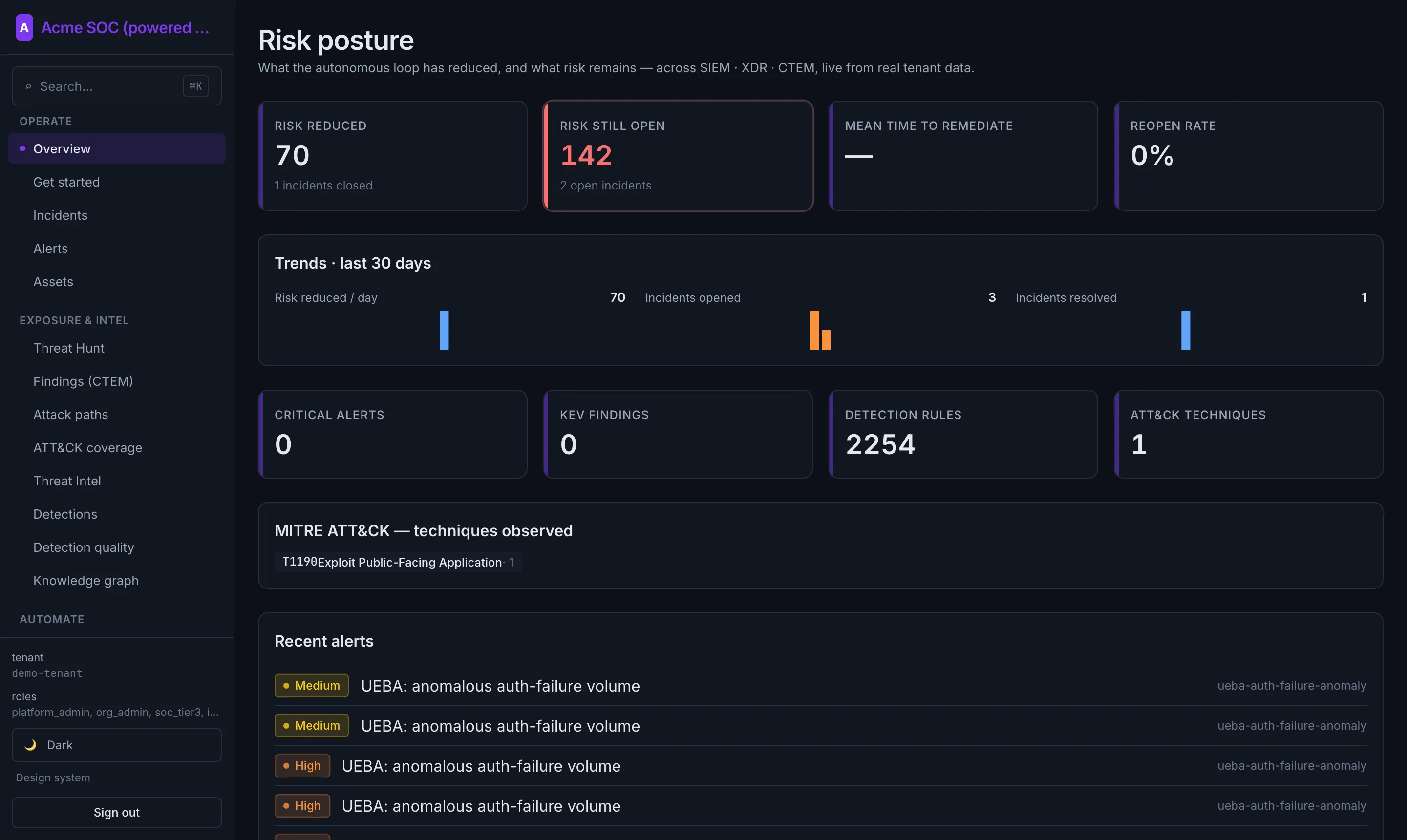
VirtueShieldX risk-posture dashboard: risk reduced, open incidents, 30-day trends, detection-rule count, MITRE ATT&CK techniques observed, and recent UEBA alerts
The risk-posture view your pilot runs on: a capture from the live demo tenant of VirtueShieldX, the same platform our analysts work in.

What the SOC covers, around the clock

24/7/365 monitoring & triage

Detection across 2,250+ MITRE ATT&CK-mapped rules with behavioral analytics (UEBA). AI triage fuses related alerts into single incidents, and analysts supervise every consequential decision, so an overnight page is worth waking for.

Incident response

Containment runs under human approval gates: isolation, credential response, and escalation execute only when a named analyst approves, with your team paged from the first action.

Exposure-aware triage

Alerts arrive with exposure context: what an attacker can actually reach. A detection on an exploitable asset that sits on an attack path to your crown jewels goes to the head of the queue.

Compliance-aligned reporting

Monthly evidence aligned to NIST, ISO 27001, and SOC 2 expectations, written so you can forward it to an auditor or an insurer without reformatting.

Tools & standards

Platform
VirtueShieldX: in-house SIEM, detection engine, and SOAR
Telemetry & enrichment
Wazuh agents, ThreatFox and curated threat-intel feeds, Trivy

What you receive

  • 24/7 monitoring where an analyst has judged every alert before it pages you
  • Incident response executed under the approval gates and escalation paths you agreed
  • A monthly service review with detection-coverage reporting your leadership can read
  • Evidence packs aligned to NIST, ISO 27001, and SOC 2 expectations, ready for auditor or insurer

Evidence

Standard response targets

P1 incidents are acknowledged within 15 minutes; lower severities follow defined tiers up to 4 hours (P4). Structured onboarding completes within 90 days of pilot conversion. These are our standard targets; final SLAs are committed in your service agreement.

Built and operated by our own SOC

Our own SOC engineers run VirtueShieldX in production on live telemetry today. Its newest capability, the fully autonomous investigate-prioritize-remediate-validate loop, completed its first end-to-end production runs in June 2026, with analysts supervising every consequential action.

About VirtueShieldX →

Our certification posture, stated plainly

Before you route telemetry to anyone, ask about their own security posture. Ours is on the record: we hold no organizational certification today and do not claim otherwise. Governance, data handling, and the evidence behind every claim on this site are published for your vendor review.

Trust & company facts →

Engagement

Ways to engage the same senior bench

Start with the 30-day pilot on your own telemetry, then continue fully managed or co-managed alongside your team, with the same engineers either way.

30-day pilot

You judge detections, triage quality, and reporting from your own environment before any long-term commitment.

Managed SOC service

24/7/365 monitoring, triage, and response on VirtueShieldX after a structured onboarding.

Co-managed

We run detection, triage, and out-of-hours cover while your team keeps response decisions and approval gates. Suits an internal SOC that needs more depth and coverage.

Who this is for

  • Mid-size firms with no overnight security coverage and no realistic path to hiring it
  • CISOs consolidating point tools into one monitored, accountable capability
  • Companies whose cyber-insurance renewal or enterprise customers now require 24/7 monitoring

Common questions

How is our telemetry and log data handled?

VirtueShieldX is multi-tenant with strict per-tenant data isolation, and the team operating it is the team that built it. Deployment and data-handling terms are agreed during the pilot and fixed in your service agreement.

What are the response targets?

P1 incidents acknowledged within 15 minutes, defined tiers up to 4 hours for P4, and onboarding within 90 days of pilot conversion. These are standard targets; final SLAs are committed in your service agreement.

Do you take automated action on our systems?

Only under a human approval gate: nothing changes on your systems until an analyst approves. Playbooks can run in dry-run (simulated) mode first.

What does the platform actually show us?

Risk posture, fused cross-domain incidents, MITRE ATT&CK coverage, detection quality, and remediation playbooks: the same screens our analysts use. See the VirtueShieldX platform page for captures from the live platform.

Who actually does the work?

Our own bench staffs the service: senior engineers holding industry certifications spanning CISSP, CEH, eCPPT, ISTQB, and AWS. The people you meet at scoping are the people who run your coverage, and no rotating offshore bench sits behind the proposal.

How are our data and the findings handled?

Engagements run under NDA, and engineers who handle client data undergo background checks. Findings and reports are shared through channels agreed at scoping and are not retained beyond the period needed to deliver and support the engagement. Data-handling specifics (storage, encryption, retention, and destruction) are documented in your service agreement; see the Trust page for our posture.

In the assurance loop

This is the detect stage. Indicators from our own offensive work become live detections here, so an attack path proven against you is one your monitoring already recognizes. See how the loop connects →

Start with a 30-day pilot

Thirty days on your own telemetry, judged on the detections and reporting it produces.